Bongsub Song

Research Portfolio of Bongsub Song, Ph.D. Researcher at ETRI specializing in Robotics, Reinforcement Learning and Field Robotics.
GripFlexer: Development of Hybrid Gripper with a Novel Shape That Can Perform in Narrow Spaces
Conference: IEEE/RSJ International Conference on Intelligent Robots and Systems (IROS), 2024
Authors: Donghyun Kim, Sunghyun Choi, Bongsub Song, Jinhyeok Song, Jingon Yoon, Dongwon Yun*
Dept. of Robotics and Mechatronics Engineering, DGIST, South Korea
Abstract
In recent years, the role of robots across industries has become increasingly diverse, and they are now required to perform complex missions beyond simple repetitive tasks. However, robots used in confined spaces that humans cannot reach or in disaster field missions have challenges in performing various tasks due to their small size. In this study, we developed a compact hybrid gripper that fuses a multi-finger gripper and a jamming gripper to perform various tasks in a confined environment. Such a hybrid gripper can have both the strengths of a multi-finger gripper that can perform various tasks and a jamming gripper that can effectively handle irregular small objects. We developed GripFlexer based on theoretical analysis and confirmed its performance through experiments by taking the task of turning a circular doorknob — one of the most difficult tasks in disaster sites — as the final target task. We also confirmed that the two grippers can interact, showing performance improvement effects when two grippers are operated simultaneously.
Key Contributions
- Novel hybrid design: Integrates a 3-finger under-actuated gripper with a compliant CFH (paired-Cross Flexure Hinge) joint and a jamming gripper into a single compact body (72 × 72 × 120 mm).
- Shock absorption: CFH-based joints reduce impact force by ~4× compared to conventional pin joints (HIC₃₆: 4.84 vs. 20.33).
- Hybrid grip improvement: Combining finger + jamming increased circular doorknob success rate from 30% → 80% and average torque by 43.3%.
- Gripping force: Maximum vertical gripping force of 10.8 N; maximum friction torque of 0.62 N·m.
Analysis
CFH Joint Stiffness
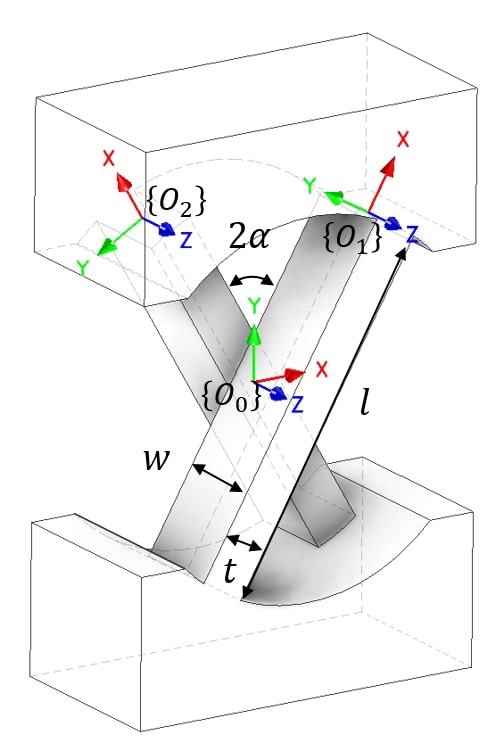
Fig. 1 — Coordinate system of the flexure joint. Cantilever beams with length l, thickness t, and width w are crossed at angle 2α. Calculated rotational stiffness: 0.0656 N·m/rad per finger joint.
Under-Actuation Finger Statics
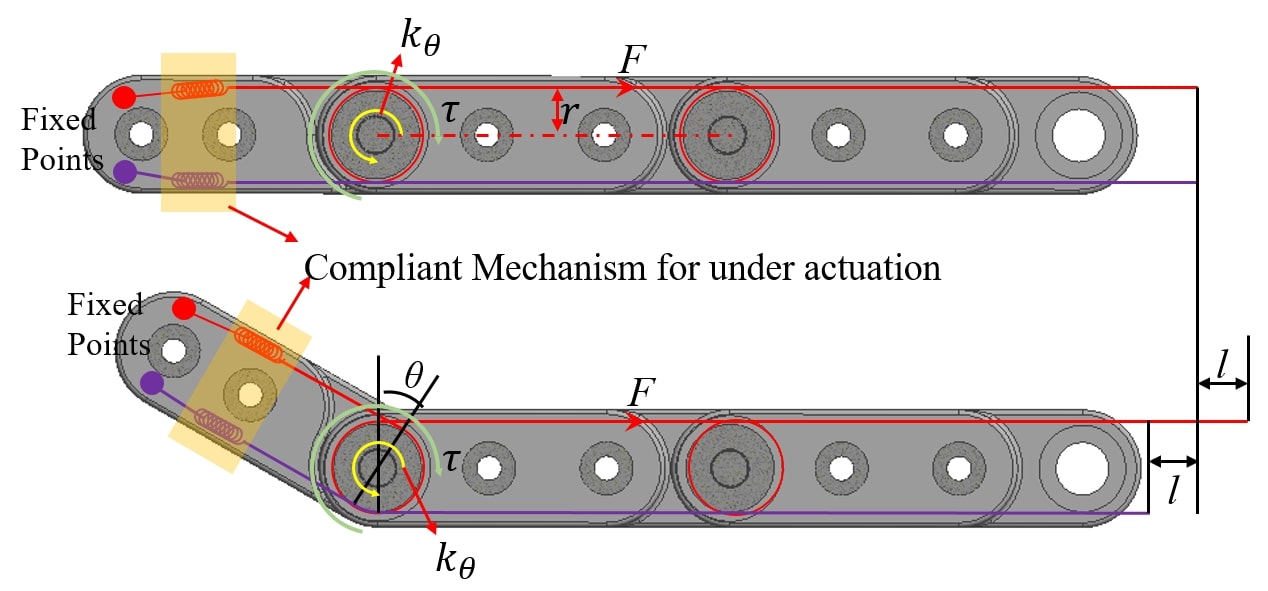
Fig. 2 — Cable path for the under-actuation mechanism. Bidirectional drive is enabled by routing the cable symmetrically around each joint center.
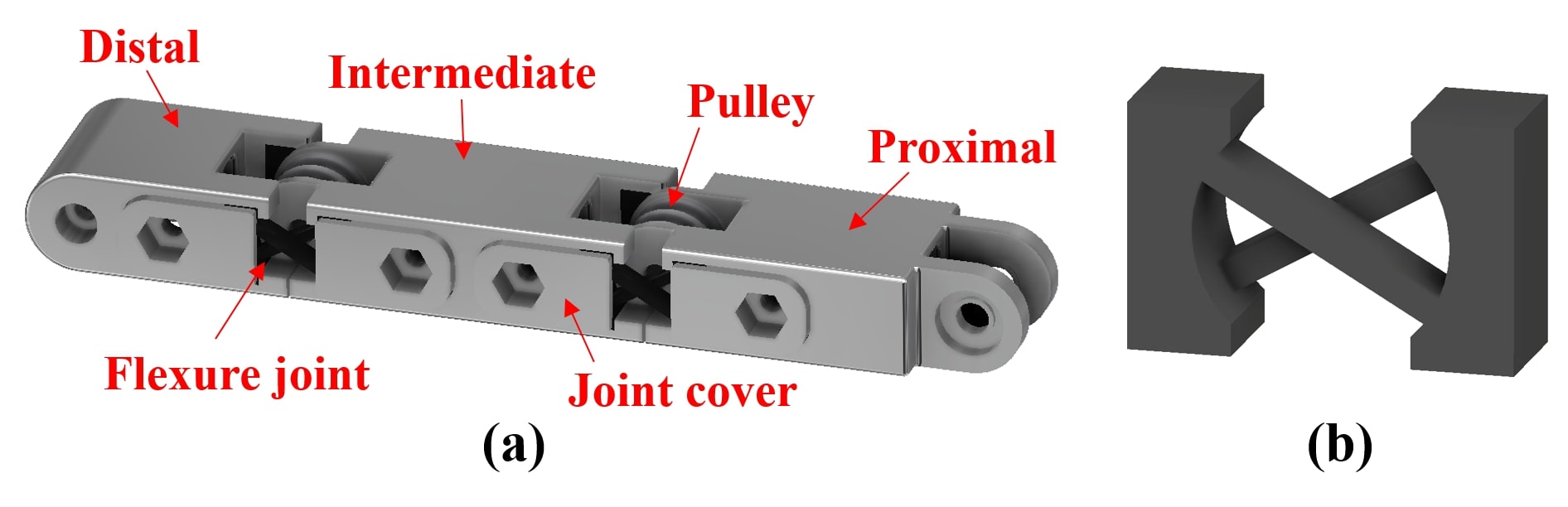
Fig. 5 — Finger design: (a) Assembled finger with three links (25/33.6/30 mm). (b) CFH flexure joint printed in nylon via FDM for high flexibility and impact resistance.
Fabrication
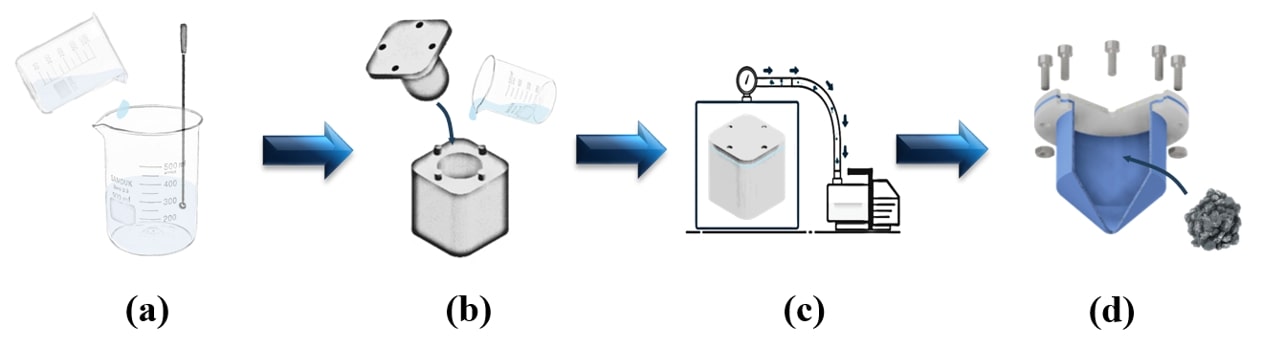
Fig. 6 — Jamming module fabrication process using Dragonskin 20A silicone: (a) silicone poured into mold, (b) vacuum degassing, (c) assembly with flexible rubber particles, (d) final jamming gripper adapting to irregular shapes.
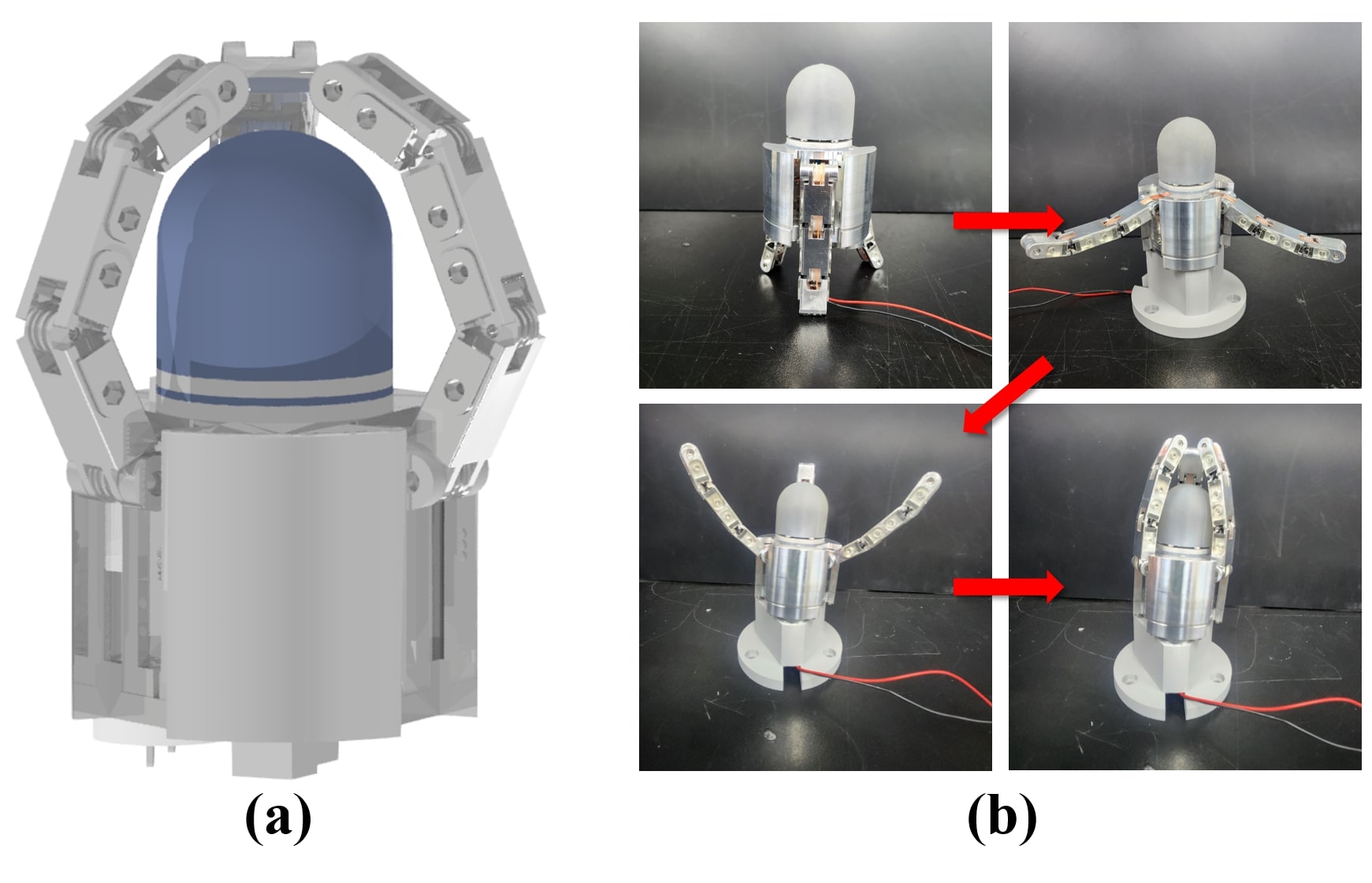
Fig. 7 — Shape and operation of the assembled GripFlexer, combining the finger module, jamming module, and base into a single compact form factor.
Experiments
Stiffness Validation & Shock Absorption
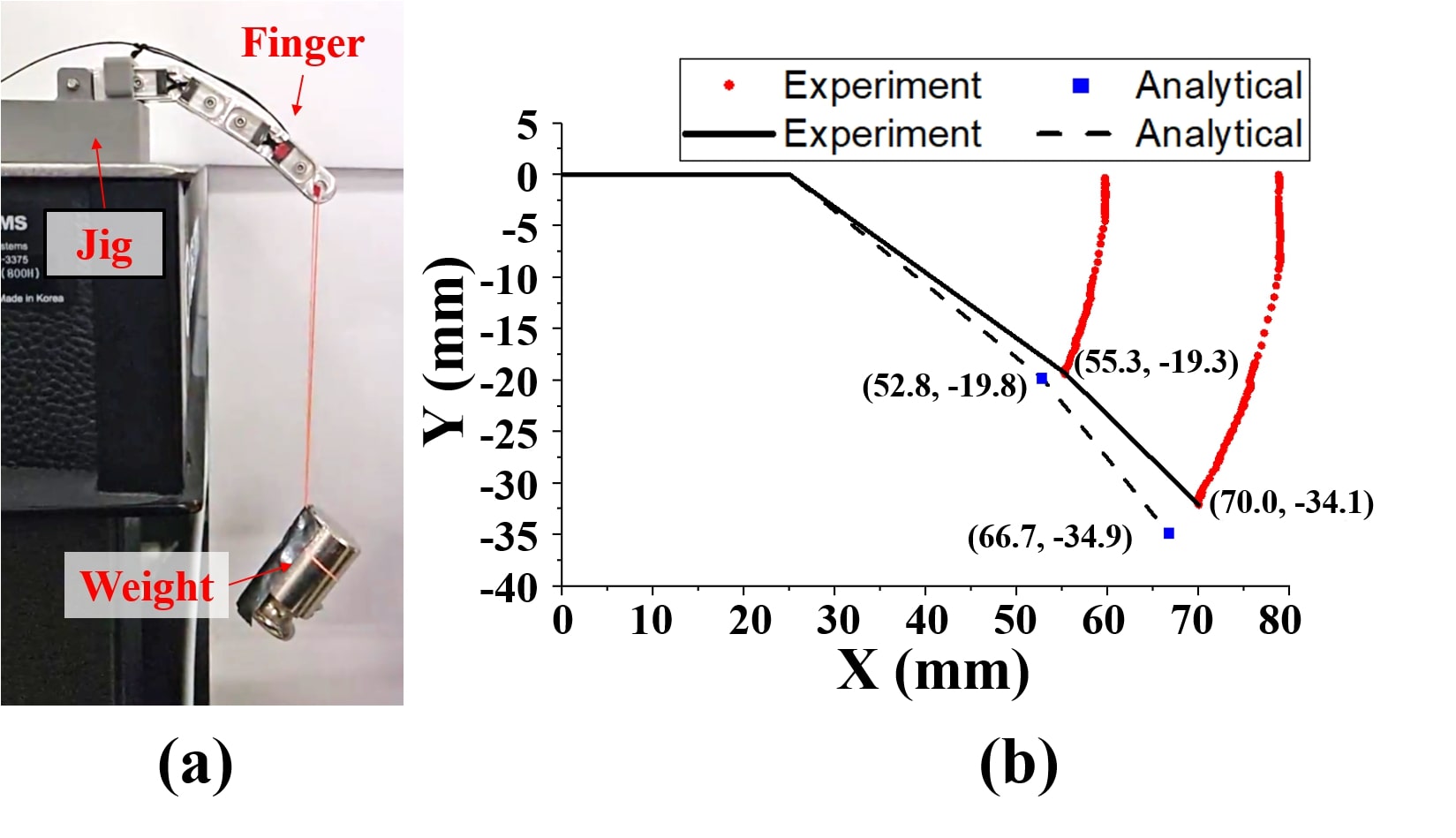
Fig. 9 — Stiffness validation experiment with a 100 g weight. Experimental fingertip position (70.0, −32.1) closely matched theoretical prediction (66.7, −34.9).
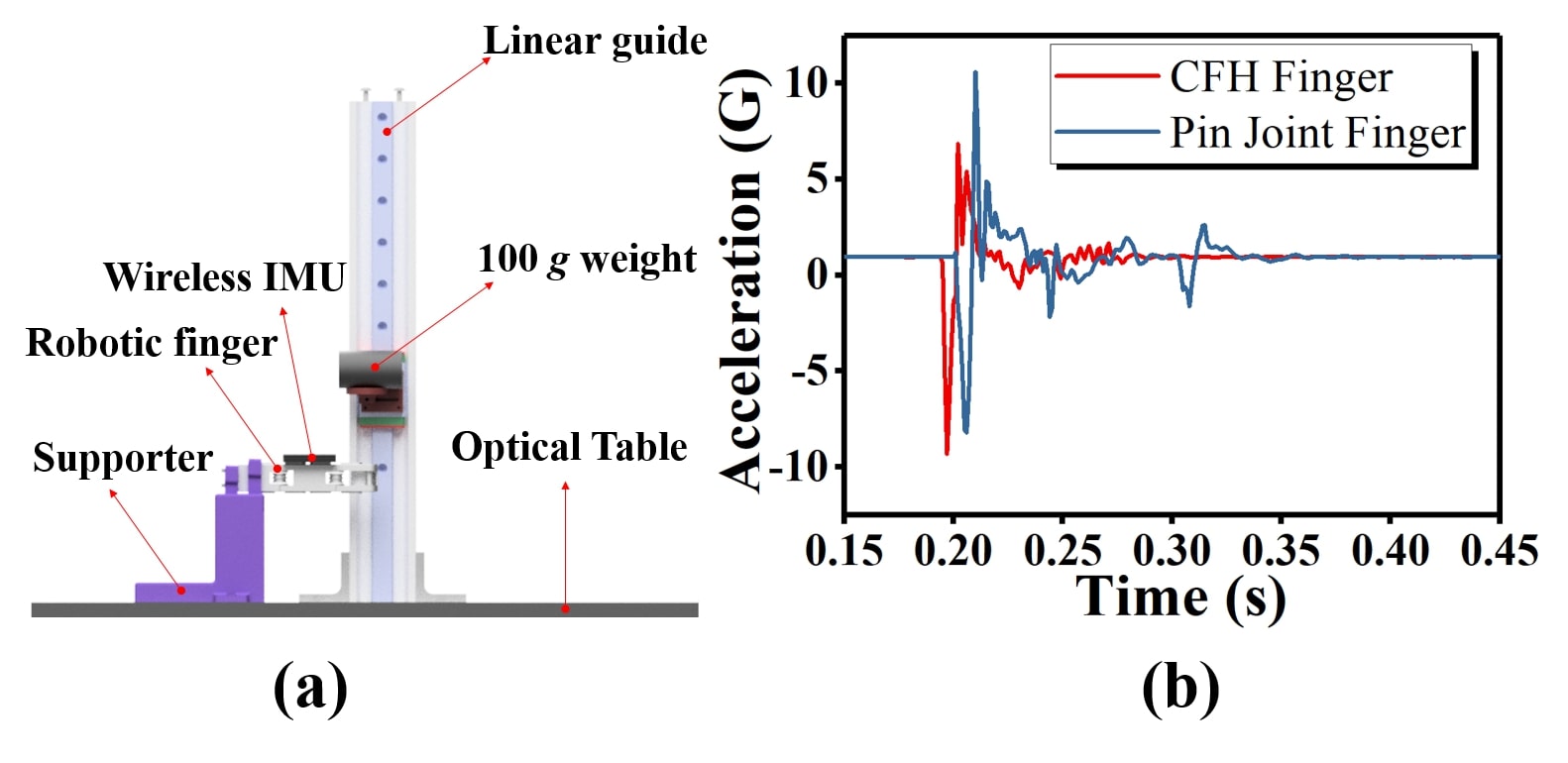
Fig. 10 — Shock absorption experiment setup. A 100 g weight was dropped from 40 cm. CFH finger achieved HIC₃₆ = 4.84 vs. pin joint HIC₃₆ = 20.33 (~4× reduction).
Doorknob Gripping & Force Measurement
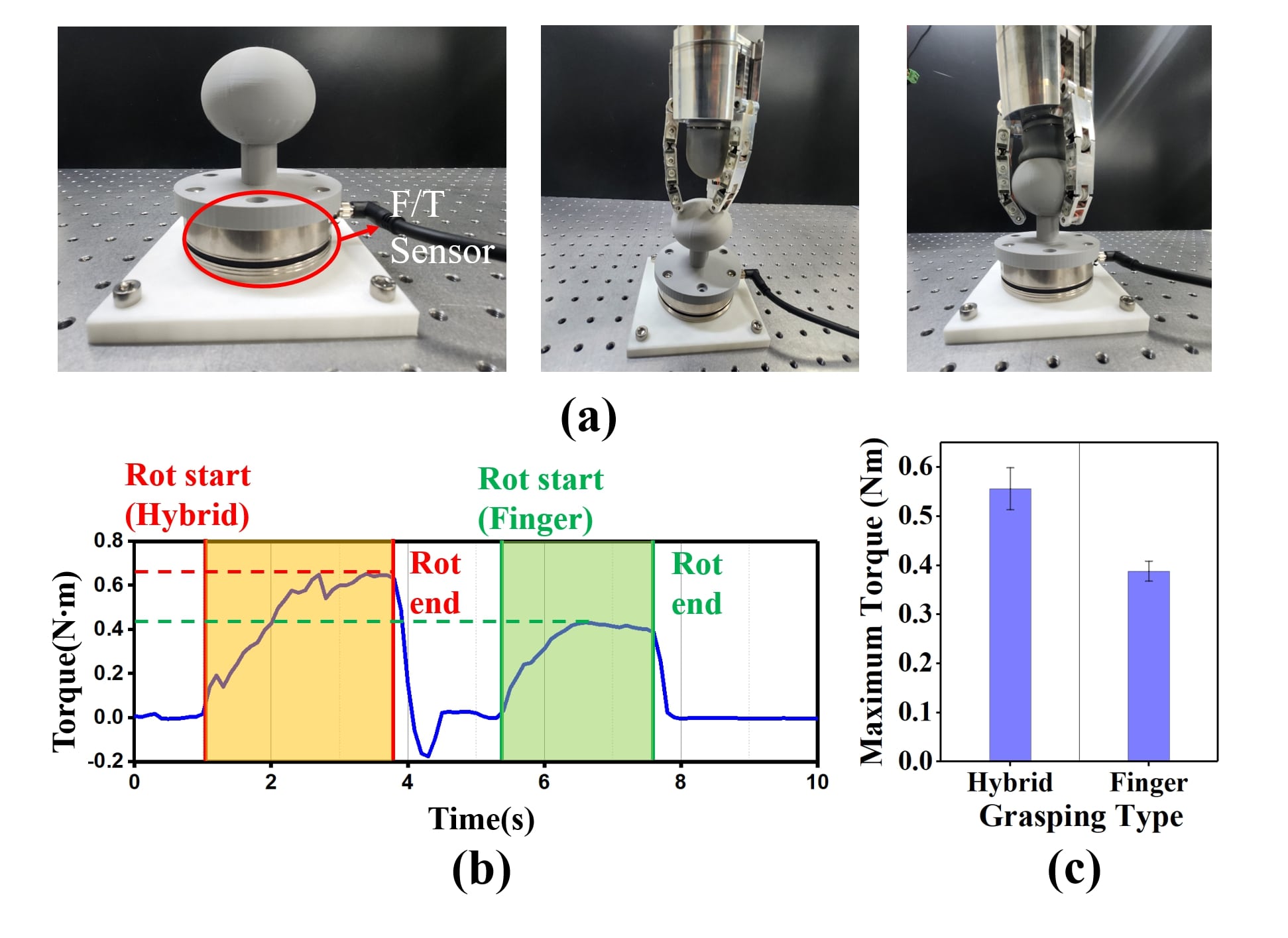
Fig. 11 — Torque measurement when rotating a circular doorknob. Hybrid drive (finger + jamming) generated up to 0.56 N·m, a 43.3% average increase over finger-only operation. Required doorknob torque: 0.416 N·m.
Grasping Force & Small Object Handling
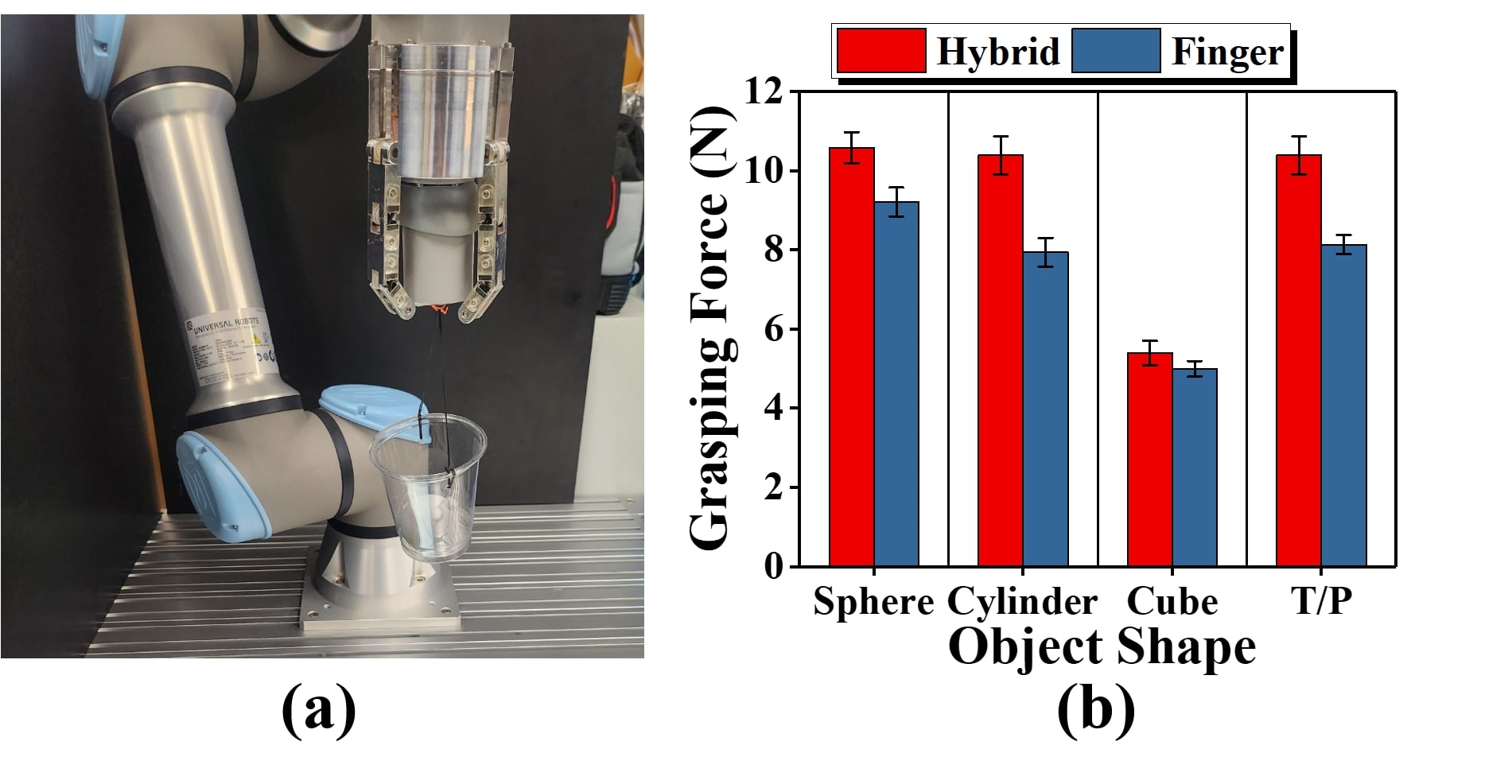
Fig. 12 — Gripping force experiment on four object shapes (sphere, column, tetrahedron, triangle). Average grip force increased by 20.3% with hybrid drive.
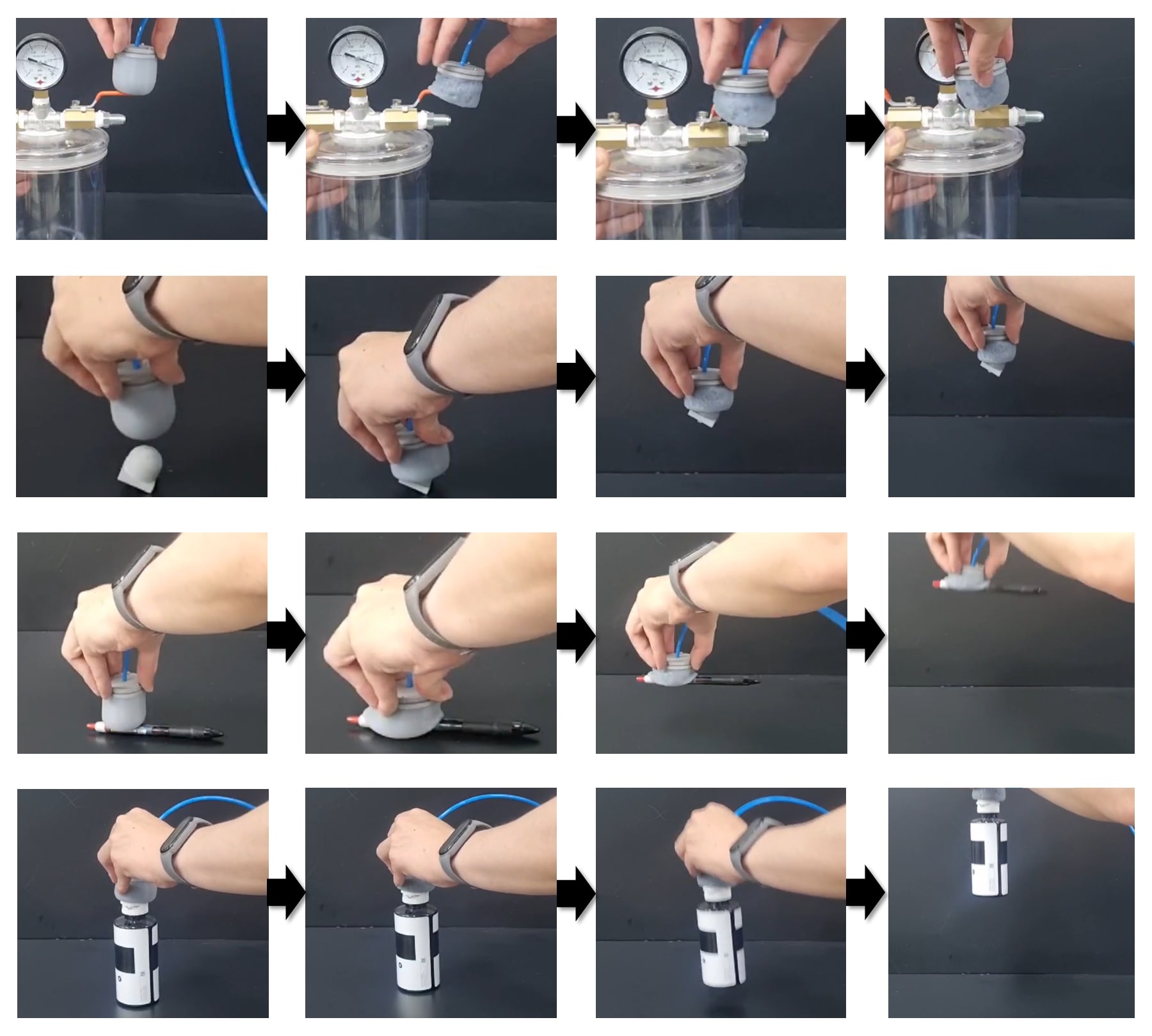
Fig. 13 — Small object grasping using the jamming module. Objects ≤3 cm diameter (pebbles, bolts, debris) that cannot be grasped by the finger alone are successfully handled.
Last updated: March 2026