Bongsub Song

Research Portfolio of Bongsub Song, Ph.D. Researcher at ETRI specializing in Robotics, Reinforcement Learning and Field Robotics.
Optimizing Snake Robot Locomotion with Decomposed Gait Pattern Representation
Journal: Integrated Computer-Aided Engineering, 2025
Authors: Bongsub Song, Insung Ju, Dongwon Yun*
Dept. of Robotics and Mechatronics Engineering, DGIST, South Korea
Keywords: Biologically Inspired Robots · Biomimetics · Model Learning for Control · Learning and Optimization for Robot Gait
Abstract
This paper presents novel Gait Decomposition (GD) and Gait Parameter Gradient (GPG) methods for enhancing snake robot control and optimization. Snake robots face challenges in parameter tuning due to their complex dynamics and the need to preserve gait characteristics during control. GD fine-tunes gait parameters while maintaining their characteristics to prevent unintended changes during the application of serpenoid curves, typical in snake robots. A key feature of GD is the use of a motion matrix to represent joint movements, ensuring the preservation of gait characteristics. This methodology classifies the robot’s gait as a motion matrix, aiding in addressing the common challenge of parameter tuning in real-world scenarios. Furthermore, we introduce the GPG algorithm, designed to efficiently optimize gait parameters by adjusting both the curve function parameters and the motion matrix. Simulations validate the effectiveness of our methods, showing that the decomposed gait closely retains the original gait’s characteristics and achieves stable optimization under various conditions. Together, GD and GPG offer significant improvements in the control, adaptability, and practical deployment of snake robots.
Key Contributions
- Gait Decomposition (GD): Separates snake robot locomotion into (1) a motion matrix encoding which joints activate at each time step, and (2) a curve function (serpenoid) that generates actual joint angle trajectories — enabling intuitive gait classification analogous to quadrupedal gait analysis.
- Gait Parameter Gradient (GPG): Optimization algorithm that tunes curve function parameters (amplitude, spatial/temporal frequency) while keeping the motion matrix fixed, so the underlying gait structure is preserved.
- Three gait classes formally defined: Slithering, Sidewinding, and Rolling are classified and represented as distinct motion matrices.
Overview
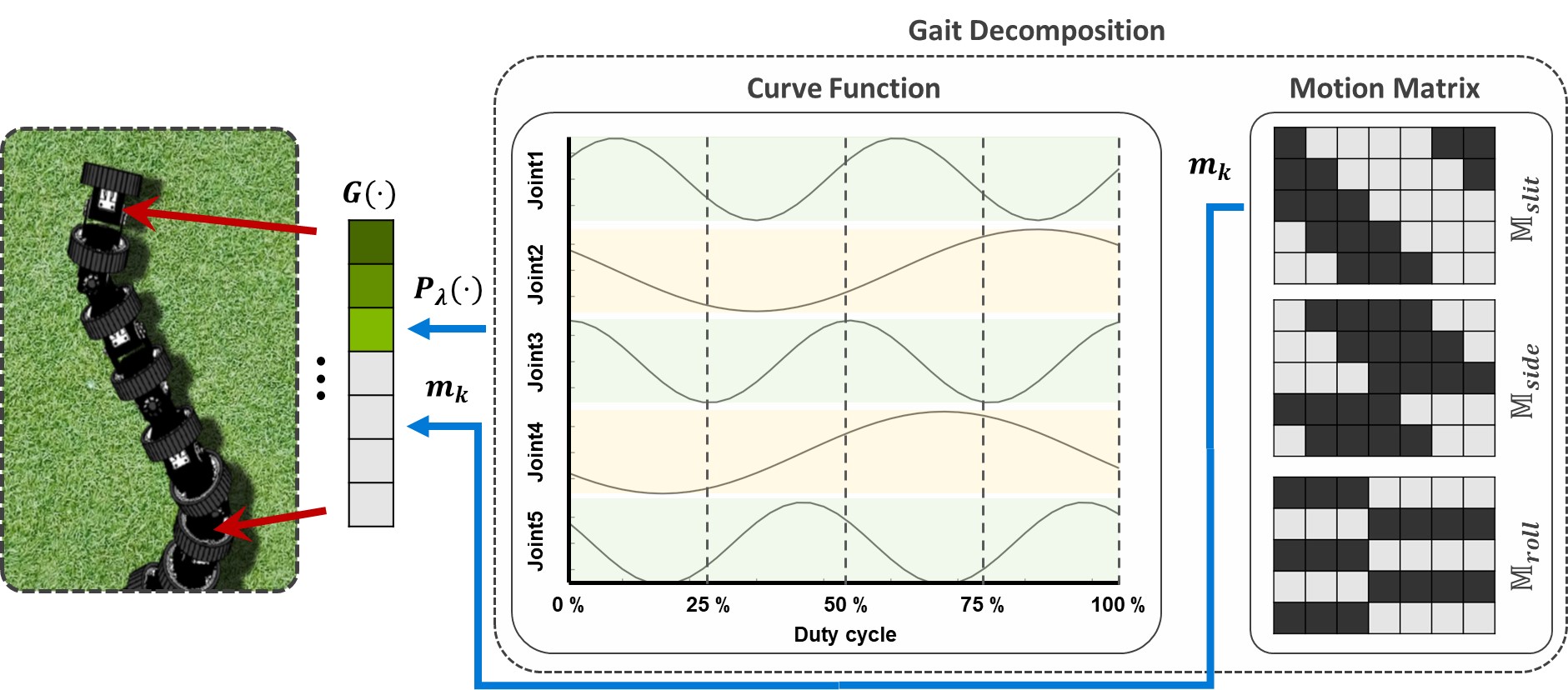
Fig. 1 — Overview of the Gait Decomposition (GD) process. The snake robot's gait is decomposed into a motion matrix (M_slit, M_side, M_roll) and a curve function P(·), which are combined to generate joint control signals.
Robot Configuration
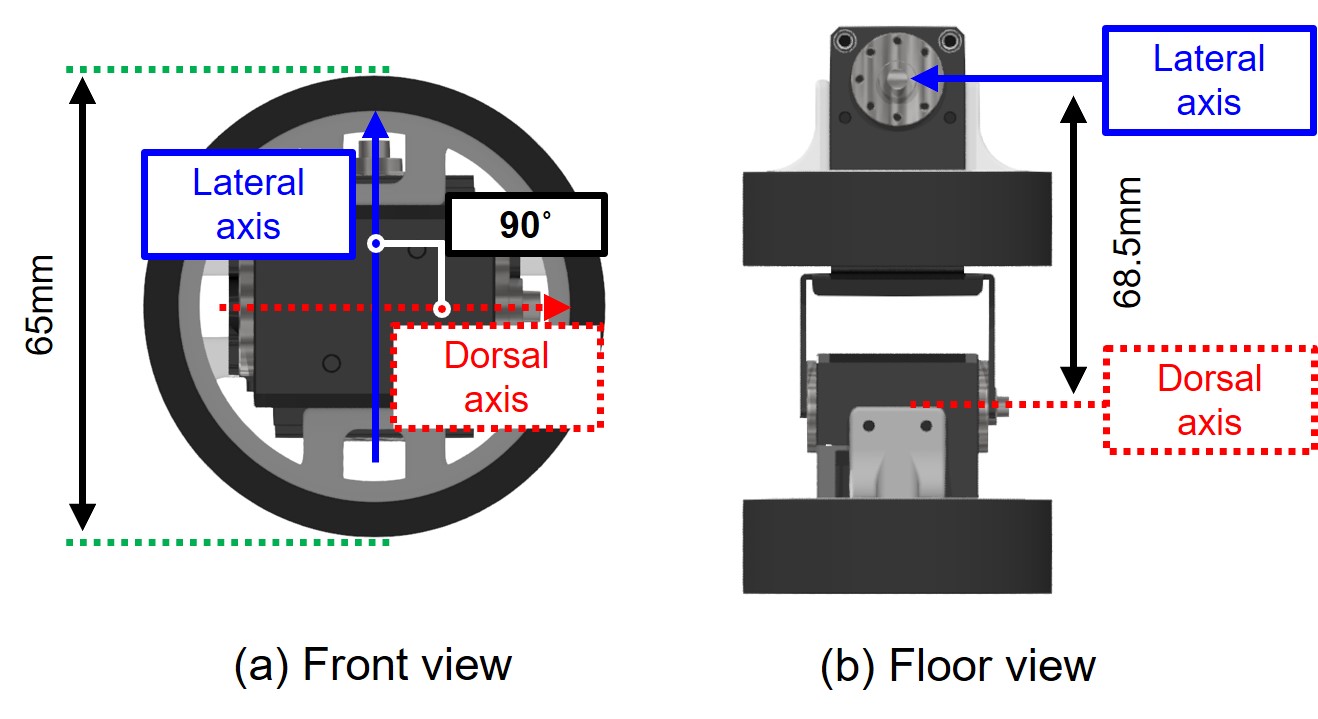
Fig. 2 — Snake robot module geometry. (a) Front view with orthogonal lateral/dorsal axes (65 mm module height). (b) Floor view showing inter-module distance of 68.5 mm.
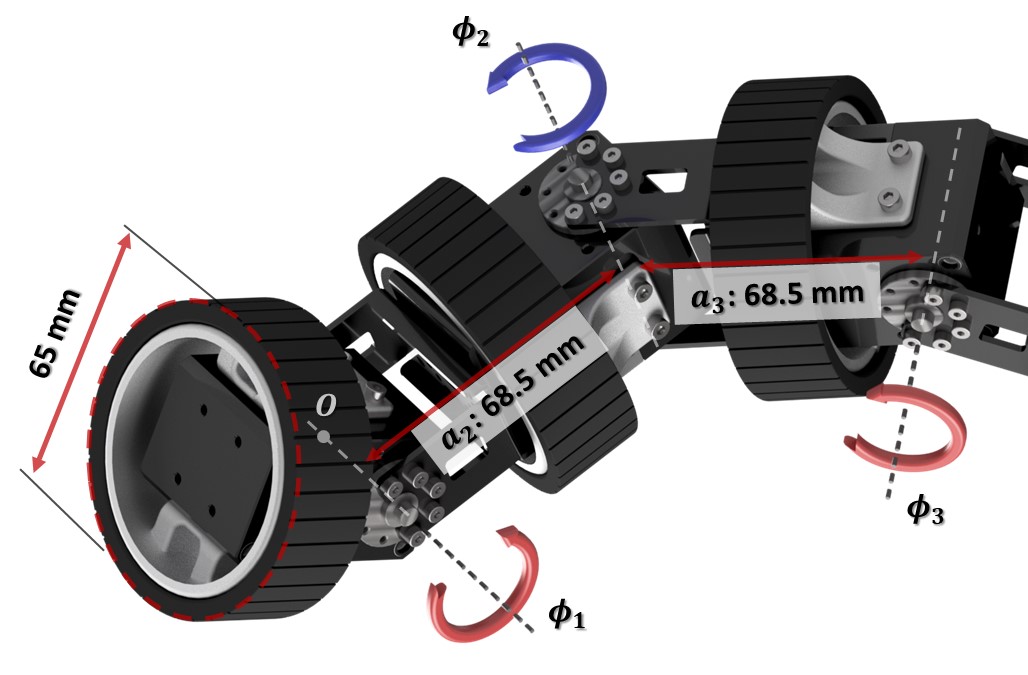
Kinematics configuration of the 14-DOF snake robot used in this study.
Gait Motion Matrices
The motion matrix encodes the activation pattern of all 14 joints over one gait cycle. Black cells indicate active joints; gray cells indicate inactive states.
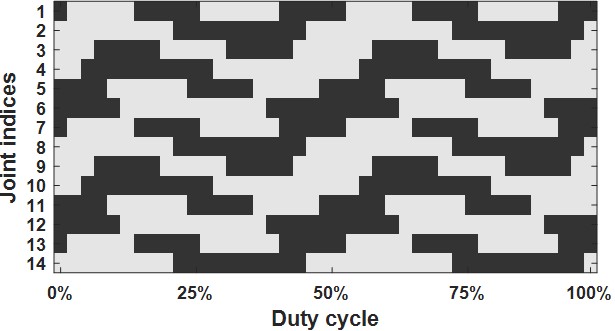
Slithering — Dorsal and lateral joints alternate in an offset pattern (η=0).
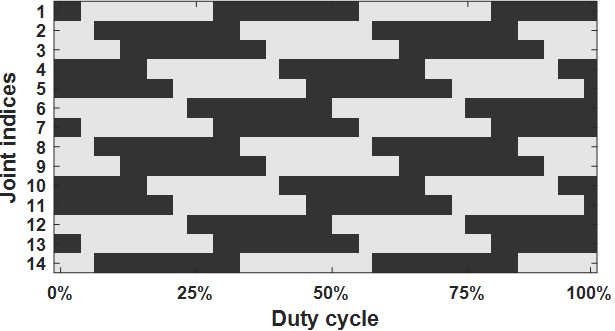
Sidewinding — π/4 phase shift between dorsal and lateral joints, inspired by rattlesnake locomotion.
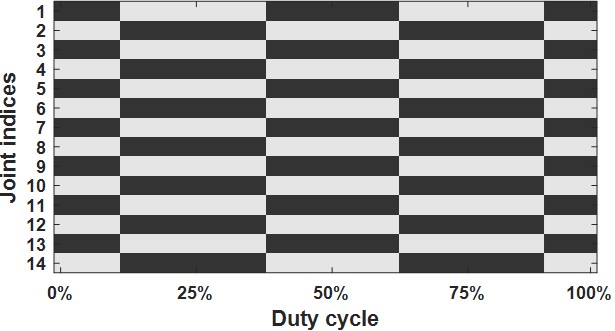
Rolling — Uniform simultaneous activation across all joints (η=π/2).
GPG Algorithm
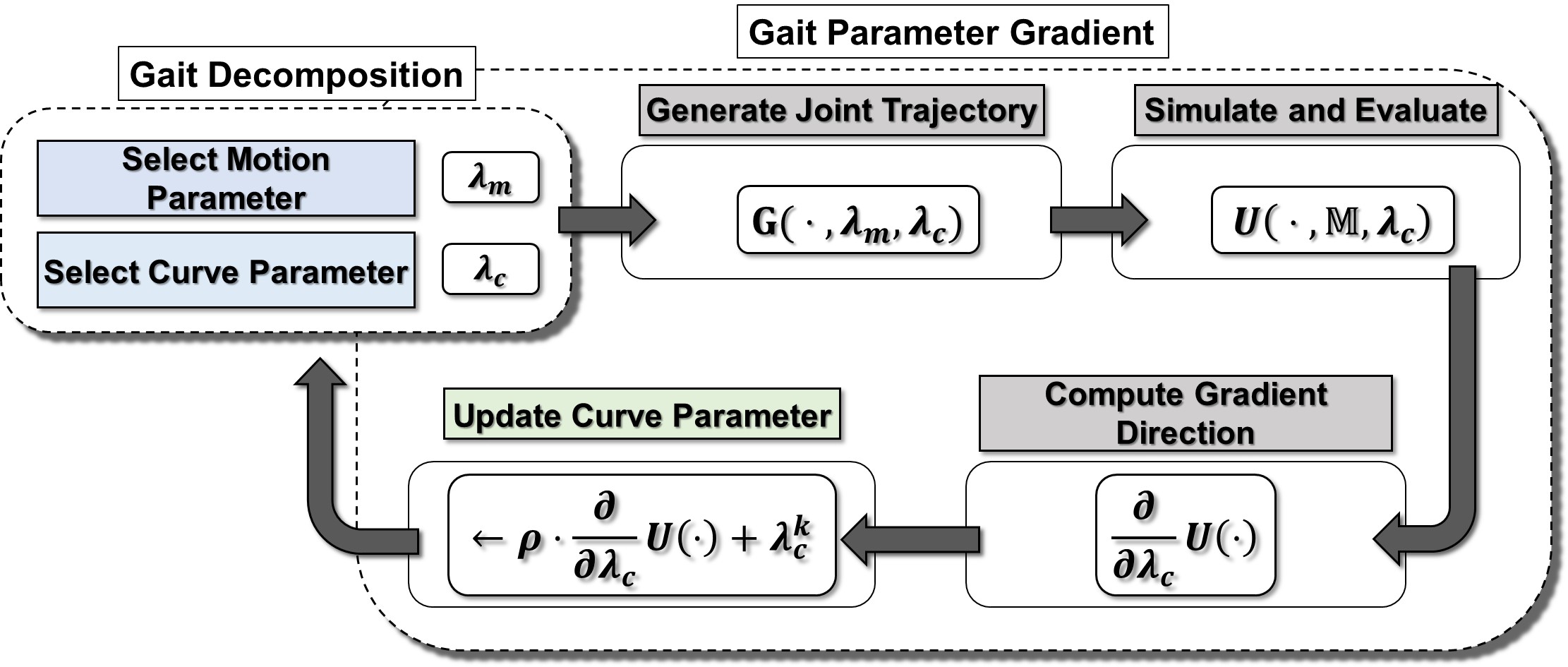
GPG optimization flow — curve function parameters are updated iteratively while the motion matrix is preserved.
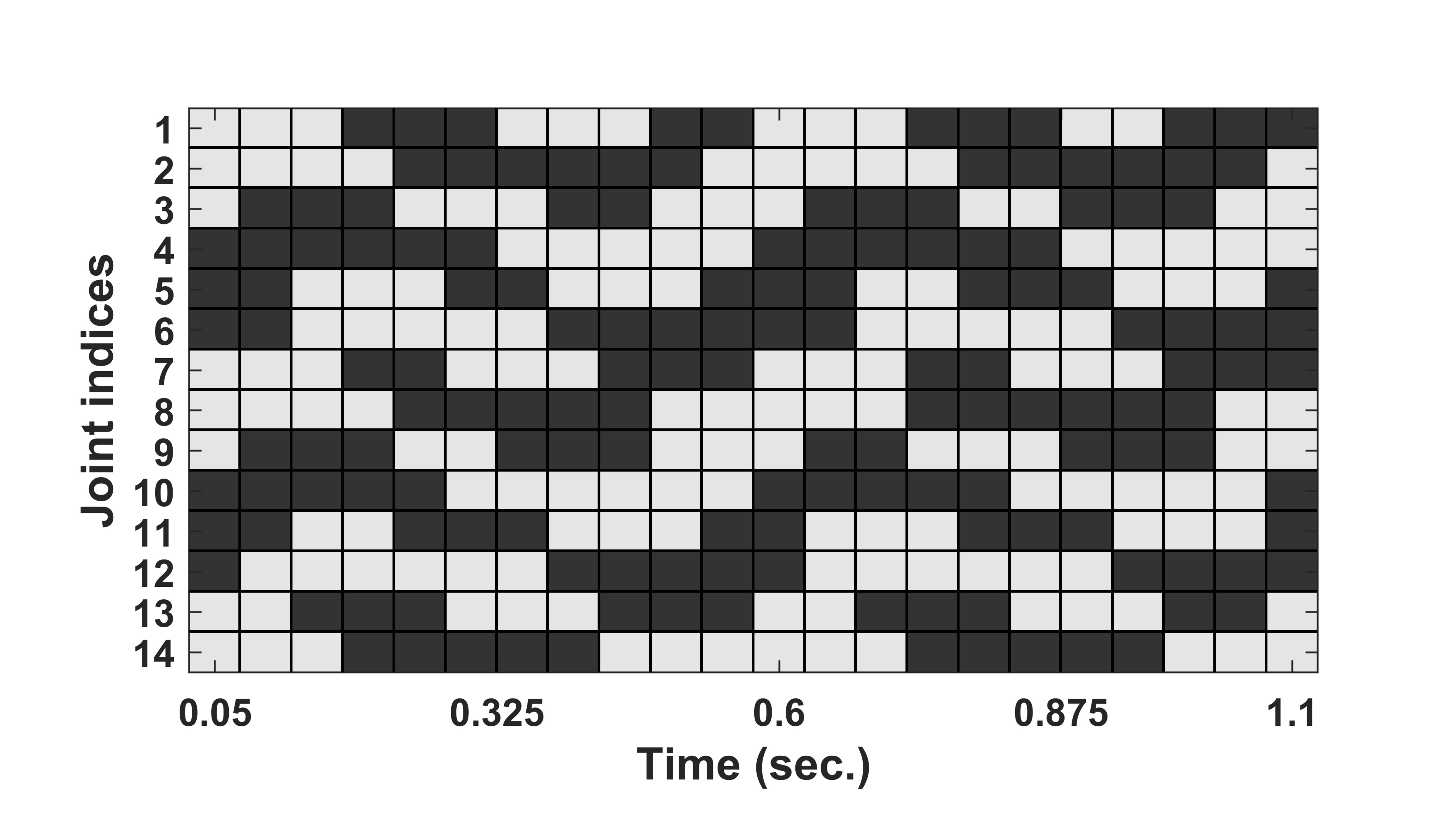
Motion matrix consistency before and after GPG optimization, confirming gait structure is preserved.
Simulation & Experimental Results
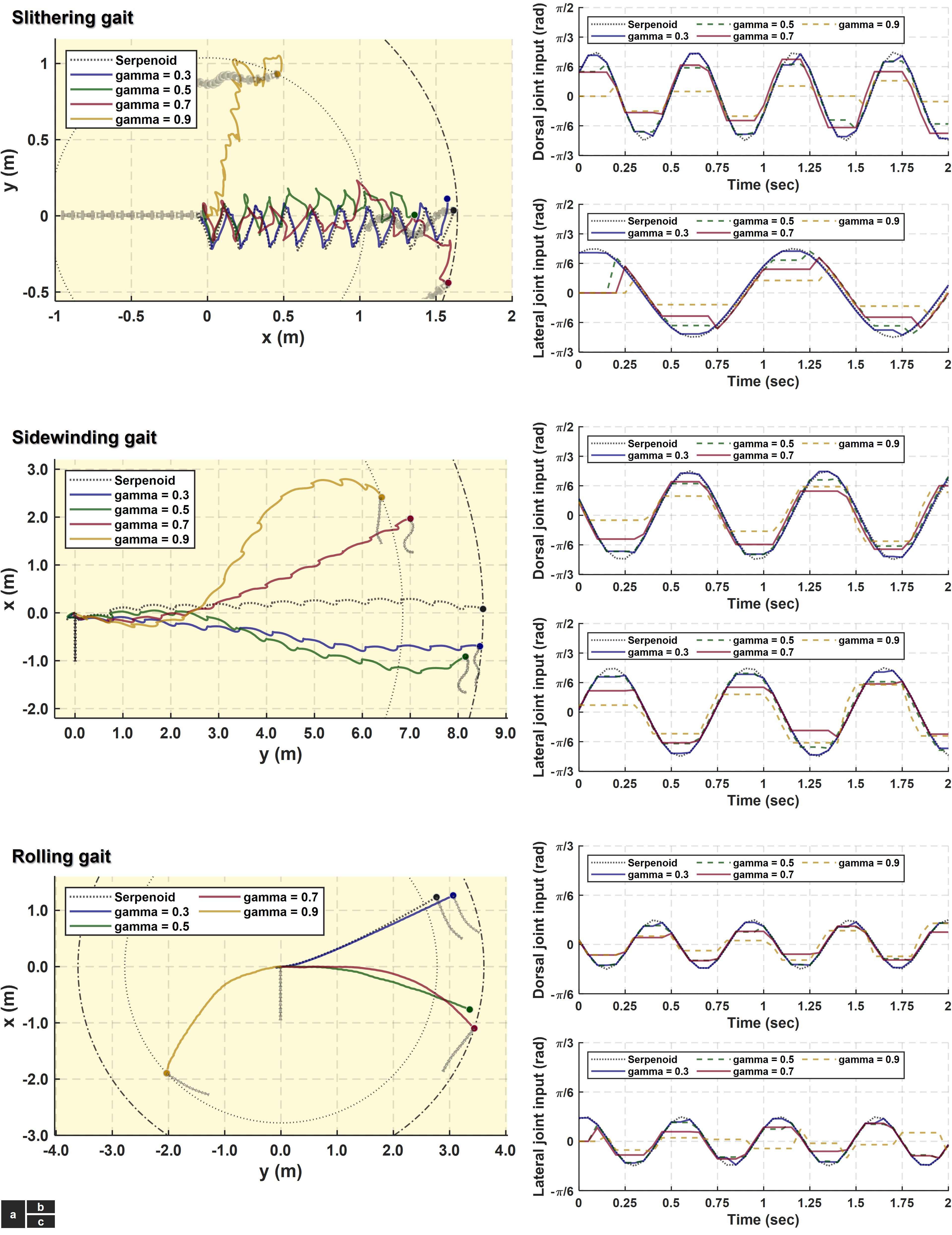
Simulation results for all three gaits under GPG optimization — forward speed and directional stability are evaluated across parameter sweeps.
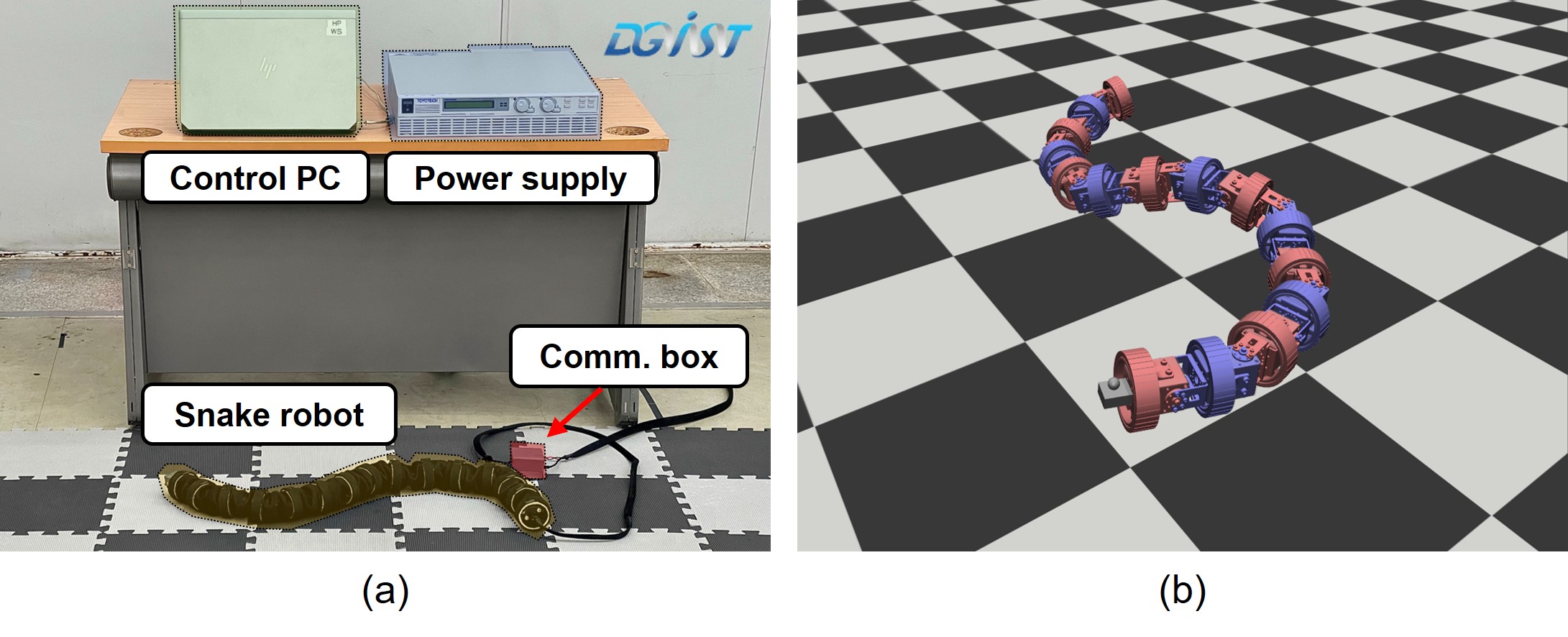
Comparison of simulation and real-robot experiment trajectories, validating the GD-based controller on physical hardware.
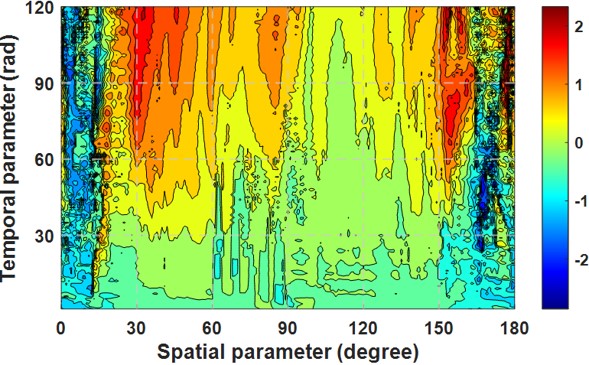
Optimization landscape — Slithering
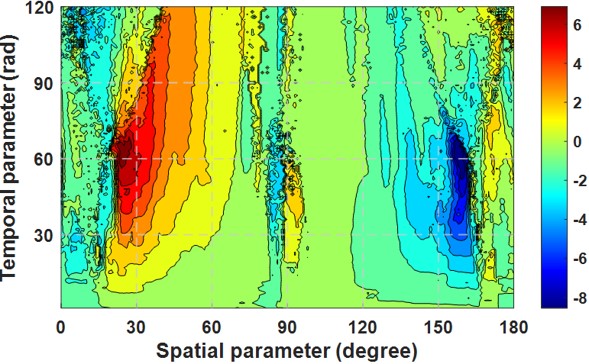
Optimization landscape — Sidewinding
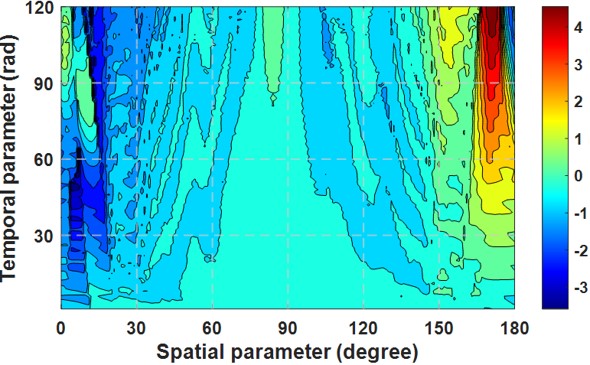
Optimization landscape — Rolling
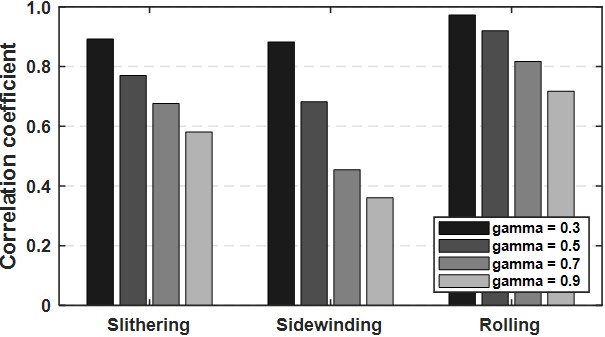
Correlation coefficient analysis between motion matrix and gait parameters, confirming that GPG optimization preserves gait structure throughout the optimization process.
Last updated: March 2026